

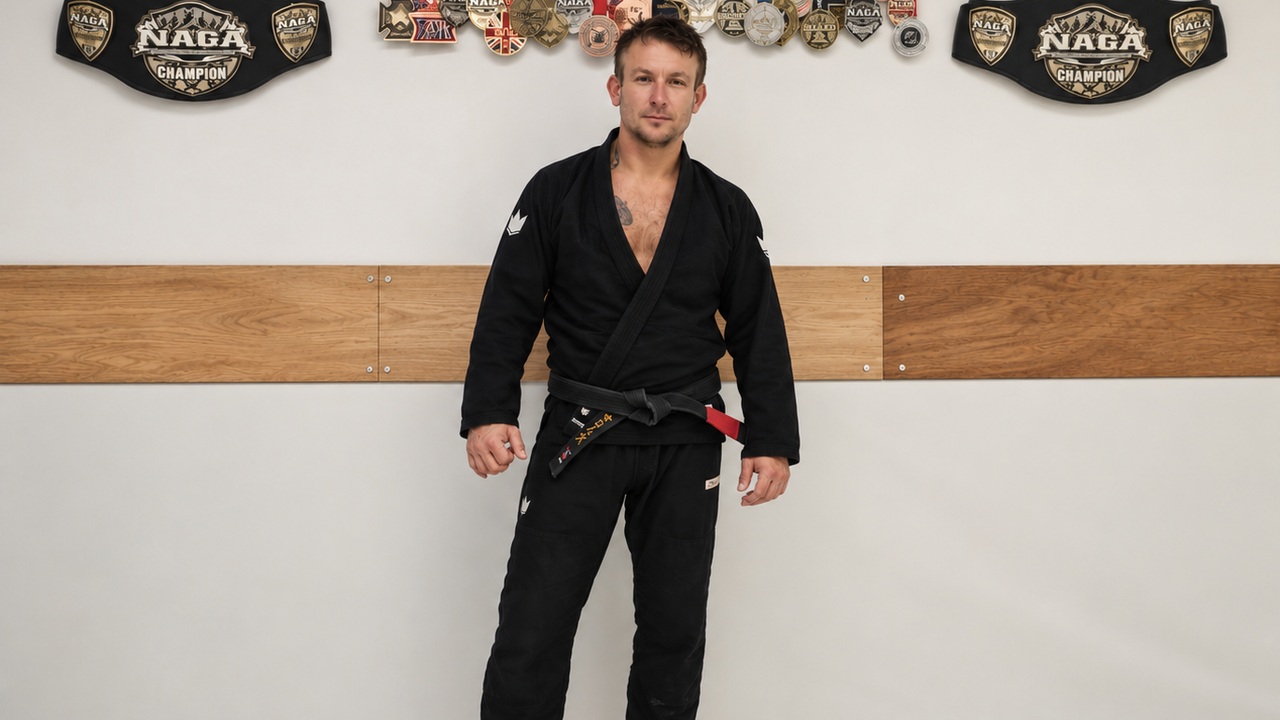
By Mariusz Madej | BJJ Black Belt & Head Coach, Kumite Combat Academy, Edinburgh
Thinking about trying Brazilian Jiu-Jitsu but not quite sure whether it’s for you?
Perhaps you’ve watched a few videos online, heard friends talking about BJJ, or simply want to try something different from your usual gym routine.
Then the questions start.
Am I fit enough? What if everyone is better than me? Will I get hurt? What if I have absolutely no idea what I’m doing?
If any of that sounds familiar, you’re certainly not alone.
I’ve been involved in martial arts since 1996 and training Brazilian Jiu-Jitsu regularly since 2011. Over the years, I’ve learned that one of the biggest challenges for beginners isn’t necessarily the training itself.
It’s finding the confidence to walk through the door for the first time.
So, if you’re considering starting BJJ, here’s what I’d want you to know.
First Things First: What Exactly Is Brazilian Jiu-Jitsu?
Brazilian Jiu-Jitsu, usually called BJJ, is a martial art based on grappling rather than punching or kicking.
You’ll learn how to control an opponent, escape difficult positions and use techniques such as joint locks and chokes.
It might look complicated when you watch experienced people training, but don’t let that put you off. Nobody expects you to understand everything on your first day.
One of the things I enjoy most about BJJ is that it’s a constant learning process. Even after years of training, there’s always something new to discover.
People sometimes describe BJJ as physical chess, and I think that’s a fair comparison. You’re constantly solving problems, making decisions and learning to think a little further ahead.
Of course, there’s plenty of physical effort involved too!
Do I Need to Get Fit Before Starting BJJ?
This is probably one of the most common concerns beginners have.
And my answer is simple: No. You don’t need to get fit before you start.
You build your fitness through training.
I’ve seen people arrive with completely different backgrounds. Some already exercise regularly, while others haven’t done much physical activity in years.
Both can find their first BJJ class challenging.
That’s because grappling uses muscles and movements you might not be accustomed to.
You may discover that someone who looks incredibly fit becomes exhausted after a few minutes of rolling, while another person who doesn’t look particularly athletic moves efficiently and conserves their energy.
Technique, timing and learning how to relax all make a difference. My advice? Don’t worry about keeping up with everyone else.
Start at your own pace, take breaks when you need them and allow yourself time to improve.
What Happens During Your First Brazilian Jiu-Jitsu Class?
Every academy does things a little differently, but let me give you an idea of what to expect.
Arriving at the Gym
Try to arrive about 10–15 minutes early.
You’ll have time to meet the instructor, get changed and familiarise yourself with the training area.
Tell the coach it’s your first session. There’s absolutely nothing embarrassing about being a beginner. Every black belt was once a white belt who knew nothing about BJJ.
If you have any injuries or health concerns, mention them before training.
The Warm-Up
Most classes begin with some movement and mobility exercises.
You might practise bridging, hip escapes (often called shrimping) or other movements that help prepare your body for grappling.
Some of these will probably feel strange at first. That’s perfectly normal.
You’re learning a new way of moving, and it takes time.
Learning Your First Techniques
Your instructor will demonstrate a technique, explain how it works and then give you time to practise with a partner.
You might learn how to escape from underneath someone, maintain a position or apply a basic submission. Don’t worry if you forget half of what you’ve just been shown.
It happens to everyone.
The important thing is to listen, ask questions and keep practising.
Will I Have to Spar?
In BJJ, we usually call sparring rolling.
This is where you practise techniques against a partner who is actively trying to respond and apply their own techniques.
Some academies introduce beginners to controlled sparring quite early. Others prefer to build their confidence through drills first.
Either approach can work when it’s properly supervised.
If you’re not comfortable, tell your instructor. You shouldn’t feel pressured into doing something you’re not ready for.
What Should I Wear to My First BJJ Class?
This depends on whether you’re attending a Gi or No-Gi class.
Gi BJJ uses the traditional martial arts uniform — a jacket, trousers and belt.
No-Gi BJJ is usually practised wearing a rash guard or fitted sports top and suitable shorts or leggings.
If you don’t have the right equipment yet, contact the academy before your first session. Many gyms can advise you on what to bring or whether a uniform is available to borrow.
A few simple things worth remembering:
- Keep your fingernails and toenails short.
- Remove jewellery before stepping onto the mats.
- Wear clean training clothes.
- Bring water.
- Wear flip-flops or shoes when walking off the mats, especially to the toilets.
- Most importantly, arrive ready to learn.
You don’t need expensive equipment to get started.
Something Beginners Often Get Wrong: Trying Too Hard
One thing I’ve noticed in martial arts is that beginners sometimes feel they need to prove themselves. They grip as tightly as possible, use all their strength and try desperately not to lose a position.
Usually, they end up exhausted.
BJJ isn’t about winning every exchange in training. It’s about learning.
If you’re constantly using maximum strength, you might actually make it harder to understand the technique. Try to relax, breathe and pay attention to what your training partner is doing.
And remember, there’s nothing wrong with tapping.
Tapping Is Part of Training, Not Failure
In BJJ, tapping means asking your partner to stop. You can tap with your hand, your foot or verbally.
If you’re caught in a submission, don’t wait until something hurts badly. Tap early, reset and continue learning.
I’ve trained for many years, and I can tell you that tapping doesn’t stop being part of BJJ when you become experienced.
It’s how we look after ourselves and our training partners.
How Often Should You Train as a Beginner?
If you’re completely new, I usually think starting with two sessions per week is a sensible approach for many people.
It gives you enough time to begin remembering techniques while allowing your body to recover. Of course, everyone is different.
Some people are happy training more frequently, while others need a little longer between sessions. What matters most is consistency.
Training twice a week for a year will generally teach you much more than training every day for two weeks and then giving up because you’re exhausted.
Try to find a routine that works with your life.
BJJ should become something you look forward to, not another source of stress.
What About Injuries? Is BJJ Safe?
I’d never tell someone that Brazilian Jiu-Jitsu is completely safe. It’s a contact sport, and injuries can happen.
You might experience bruises, muscle soreness or minor strains. More serious injuries are also possible, particularly when people train carelessly or ignore their limits.
That’s why choosing the right training environment matters.
A good academy should have instructors who take safety seriously, encourage controlled training and make it clear that respecting your partner is more important than winning.
As a beginner, you also have responsibilities.
Listen to instructions, communicate with your partner, avoid sudden uncontrolled movements and stop when something doesn’t feel right.
If you have an existing injury or medical condition, seek appropriate medical advice and let your coach know.
You don’t need to be fearless to train BJJ. You need to be sensible.
How to Choose the Right BJJ Academy
Not every gym will be the right fit for every person, and that’s fine.
Before joining, I’d encourage you to visit, try a class and pay attention to how you feel. Is the instructor approachable?
Are beginners given enough attention?
Do experienced students help newer people? Is the training area clean and well maintained? Does the timetable work with your lifestyle?
And perhaps most importantly, do you feel comfortable coming back?
I’ve always believed that the atmosphere in a martial arts academy matters just as much as the techniques being taught.
You can have excellent facilities and highly experienced competitors, but if beginners feel unwelcome, something important is missing.
At Kumite Combat Academy in Edinburgh, where I coach, students have the opportunity to explore Brazilian Jiu-Jitsu, Submission Grappling and various striking disciplines. This variety allows newcomers to experience different aspects of martial arts and find something they genuinely enjoy.
But wherever you choose to train, look for a place where you feel supported and encouraged to improve.
Your First Three Months: What Should You Expect?
Here’s something I wish more beginners understood.
You’re probably not going to feel particularly good at BJJ after your first few classes.
You might spend a lot of time underneath more experienced students, struggling to remember what you’ve learned.
You may feel like everyone else knows exactly what they’re doing. That’s normal.
At first, your goal shouldn’t be to submit everyone or learn complicated techniques. Instead, concentrate on small improvements.
Perhaps you remember how to escape a position that confused you last week.
Maybe you manage to stay calm instead of panicking when someone applies pressure. Or perhaps you simply make it through a full class without feeling completely exhausted. Those are all achievements.
Progress in BJJ isn’t always obvious from one session to the next.
Sometimes you only realise how much you’ve improved when you look back several months later.
Do You Have to Compete?
Absolutely not.
Competition is a great opportunity for people who enjoy testing themselves, and it can be a valuable part of martial arts development.
I’ve competed over the years and learned a great deal from those experiences. But competition isn’t everyone’s goal.
Some students train for fitness. Others want to develop self-defence skills, meet new people or simply have an enjoyable activity outside work.
All of those are perfectly valid reasons to train.
You don’t have to become a competitor to become good at Brazilian Jiu-Jitsu.
One Last Piece of Advice: Just Give It a Try
If there’s one thing I’d say to someone thinking about starting Brazilian Jiu-Jitsu, it’s this:
Don’t wait until you feel completely ready.
You don’t need to lose weight first. You don’t need to be stronger.
You don’t need to know the rules, understand submissions or have any martial arts experience. You just need to find a good academy and turn up for your first class.
You might discover that BJJ isn’t for you, and that’s okay too.
But you might also discover a sport that challenges you, introduces you to some great people and becomes an important part of your life.
I started my martial arts journey back in 1996, and I’m still learning today.
That’s one of the things that makes martial arts so rewarding. There’s always another technique to understand, another challenge to overcome and another opportunity to improve.
And remember, everyone you see training confidently on the mats had a first day once.
Your first day could be today.
About the Author:
Mariusz Madej is a Brazilian Jiu-Jitsu black belt under Roberto Atalla of Rio Grappling Club and the owner and head coach of Kumite Combat Academy in Merchiston, Edinburgh, Scotland.
His martial arts journey began in 1996, with experience in Aikido, Taekwon-Do, Boxing and Brazilian Jiu-Jitsu. He is an experienced competitor and qualified martial arts referee.
Through his coaching, Mariusz enjoys helping beginners build confidence, develop practical skills and discover the benefits of martial arts.
TRAIN. LEARN. PROGRESS.